
Regenerative Farming and the Abundance of September’s Harvest Haul
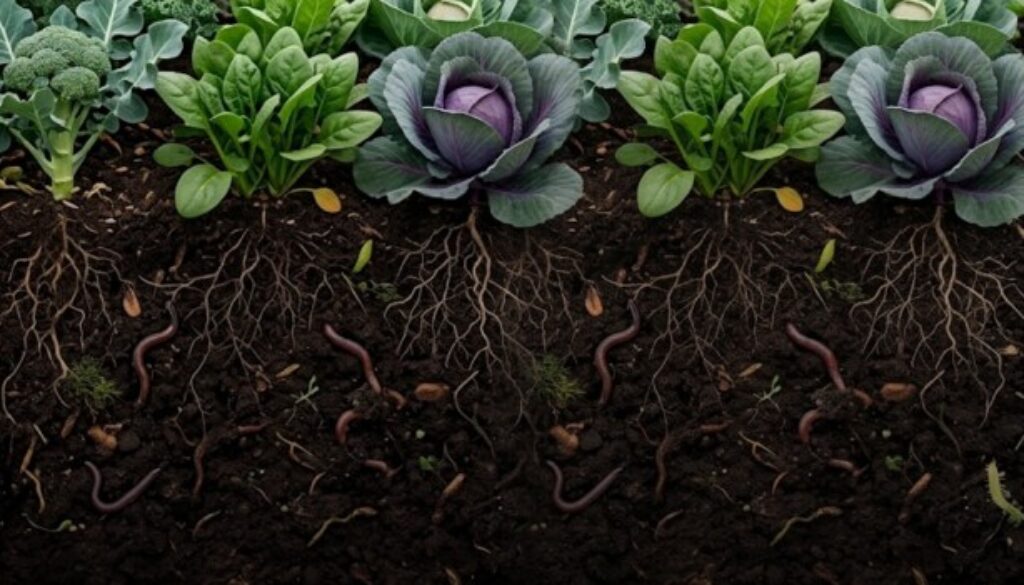
Local farmers’ markets and harvests of summer produce are still in full swing as we return to routine and see summer winding down. Local, fresh, and nutritious, however, is only part of the plan for our long-term health. It’s got to do with the dirt, specifically: how healthy is the soil that grew it. Enter Moondust’s introduction to ‘regenerative farming.’
Soil is more than scenery
Soil, after all, just lies there as we drive to a berry farm or orchard with a u-pick option. The plants we have learned to love for their health-giving properties and delicious satisfaction just happen to stand in it. Yet, if you pay attention and get up close you will understand that it is living system of bacteria, fungi, and microorganisms that cycle nutrients, build plant resilience, and can directly affect how nutritious the food that is grown in it turns out to be.
Conventional vs Regenerative
Conventional agriculture tends to work best when it is made up of single-crop fields, synthetic fertilizers for fast and predictable growth, tilling and herbicides to manage weeds, and bare soil left exposed between plantings.
Why? Because it is efficient, but then it is also a repetitive model of production. It becomes like a machine that never rests and has no time built in for restocking its parts.
Regenerative agriculture is the alternative finally gaining in understanding nature’s best practices. It is gaining traction for its logic being closer to how land actually wants to behave. Farmers rotate and diversify crops, so pests and weeds are kept in check by the ecosystem itself rather than by chemicals. They try to disturb the soil as little as possible, respecting its layered, living structure and leaving it intact. You may have also heard about allowing grazing animals to cycle through fields naturally, between plantings, returning carbon, nitrogen, and organic matter to the ground.
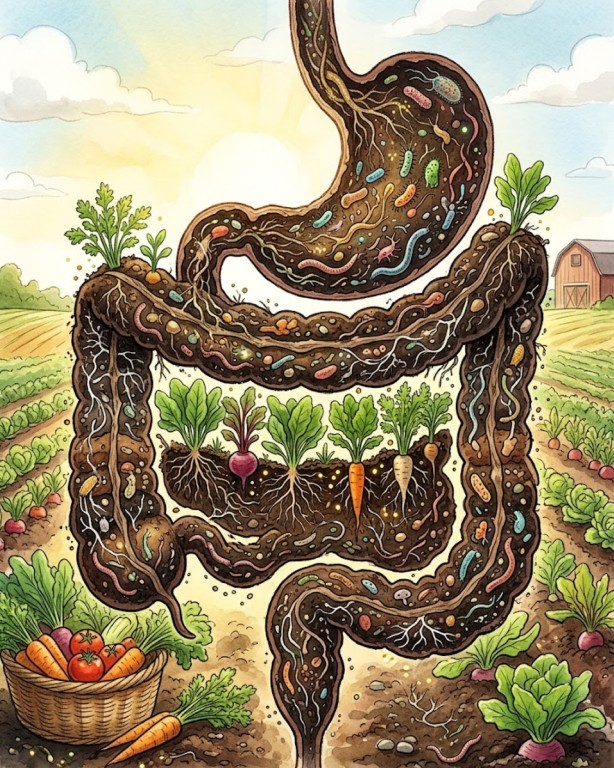
You can liken the regenerative process to what Moondust has promoted in earlier posts about eating, so we have a diverse, well-fed gut microbiome. A healthy, diverse microbiome, or living canvas, helps keep “bad guy” microbes in check simply by crowding them out with healthier competition!
The Research Is Catching Up to the Farmers
Through the dedication of regenerative farmers and researchers devoted to the preservation of our topsoil, the aim is to improve the viability to grow enough food that is also healthy. 2025 literature review synthesizing research from 2000 to 2025 on regenerative and organic agriculture found that crops grown under these systems such as leafy greens, grapes, carrots and more showed measurable increases in vitamin C, zinc, and polyphenols, alongside reductions in nitrates and pesticide residue. That review makes the connection between those nutrient shifts to the larger role of chronic disease prevention and immune system support. This is due in part to polyphenols and antioxidant compounds in the produce that support how the body manages inflammation.
The link to our own internal human ecosystem is how regenerative practices build a more diverse soil microbiome. Soil diversity supports better nutrient cycling in the plants being grown for our consumption, so their diversity leads to what we now know is the much sought after gut diversity in our bodies. (Sources: Regenerative Organic Agriculture and Human Health review, PMC (2025); “From Soil to Health,” Frontiers in Nutrition (2025); Regenerative Organic Alliance and Rodale Institute certification standards (2025–2026).
Calming note: None of this means conventionally grown produce is dangerous, or that you need to grill farmers at your local market as to their practices. This post is meant to bring attention to understanding that “local” and “regenerative” may not be identical, even though our weekend trips, with canvas reusable totes in hand make us feel that we are somehow bagging both in the bargain of the trip to stock up. (More on this below)
What Your Market Trip Actually Looks Like
September is a great month to put both goals into action, local and regenerative. Harvest season is when small and mid-size regenerative growers have the most to show for a full season of soil-building.
Here are a few practical questions you might ask about or learn from over time when standing at a vendor’s booth or surveying your local market’s offerings:
- Ask what’s growing next to what? A farmer who can tell you they’re rotating beans after corn, or that they cover-crop their fields in the off-season, is usually farming with soil health in mind — regardless of whether they use the word “regenerative” on their sign.
- Look for visible biodiversity, not just tidy rows of one thing. Mixed plantings, a few weeds tolerated at field edges, pollinator strips-these are small tells.
- Buy the ugly ones. Uniform size and perfect color are markers of high-input, high-consistency conventional systems, not necessarily of nutrient density. Regeneratively grown produce is often more variable in appearance and no less good for it.
- Don’t overhaul your grocery budget to chase this. A late-summer trip to the market that adds a few regeneratively or locally grown items into a week that’s otherwise ordinary is a completely reasonable, sustainable way to do this better than an all-or-nothing swap that burns out by October.
A step back to what “regenerative” actually guarantees a consumer
We know about “organic,” which is a federally regulated term in both the US and Canada with a legal definition behind it, “regenerative” currently isn’t. Any grower, brand, or packaged good can put the word on a label with no third party checking their work. That doesn’t mean the claim is false. Most small farmers using the term are doing exactly what they say, but it does mean the word alone isn’t proof of anything.
Some certifications do exist and are a verification for those who prefer an identifiable label:
- Regenerative Organic Certified (ROC) : the most established label, built on top of USDA Organic standards with added requirements for soil health, animal welfare, and fair treatment of farmworkers. It’s audited by trained third parties and shows up as Bronze, Silver, or Gold on packaging.
- Regenified: a newer, tiered certification (also used by some Whole Foods suppliers) that verifies practices and outcomes without requiring organic certification first, which makes it more accessible to conventional farms transitioning toward regenerative methods.
- Soil Carbon Initiative and A Greener World : smaller programs, but useful ones, with a sharper focus on soil carbon and animal welfare outcomes specifically.
Again, the local farmers’ market booth without a certification logo just means it is a small operation for whom third-party auditing is too expensive to pursue. So, talking to the farmer can yield a reliable signal. Unlike a store-bought product where labels are key, here you can ask the person who grew what you want to put on your dinner table, just hours after it was picked.
The Bigger Environmental Picture
There’s an environmental argument for regenerative agriculture too.
Soil that holds more organic matter also holds more water and more carbon. This matters as growing conditions get less predictable. In this post, Moondust’s focus is that the food system that’s best for your body and the food system that’s best for the planet are, for once, pointing in roughly the same direction. That’s rare enough to be worth making a trip to the market.
So, this September, when you’re loading up on the last of the tomatoes and the first of the winter squash, take time to consider something beyond the colourful abundance of your haul and its nutrients. Consider what happened underground, months before any of it made it to the table and all the people who care for the earth.
See more posts on the foods, habits and lifestyle choices for glowing health Moondust Cosmetics® website.
Join us on social media
Facebook, Instagram, YouTube.
Drop a line to comment or send in a question (EMAIL) info@moondustcosmetics.com
