Eating Well Through the Season: The Mediterranean Way, Canadian Style

In this post, Team Moondust Cosmetics™ shares tips to bring the traditional Mediterranean fundamentals, into North American kitchens and food choices, especially in the colder months. If you’ve read the piece on oxidative stress, you’ll see that foods recommended to support your body’s defenses show up in this expanded post. Read on to enjoy and benefit from the most thoroughly studied dietary patterns in the world.
What “Mediterranean” actually means
There is actually no single Mediterranean diet. People in Southern Italy, Greece, Spain, Morocco and Lebanon eat differently from one another. What researchers describe is a shared pattern that emerged in the region’s traditional food culture, one so distinctive that UNESCO recognized it as an element of intangible cultural heritage in 2010.
That pattern is built on:
- Vegetables, fruit, and legumes – eaten at nearly every meal
- Whole grains such as barley, farro, bulgar, and whole grain bread
- Extra virgin olive oil as the main fat
- Nuts and seeds as everyday toppings and snacks
- Fish and seafood a couple of times a week or more
- Moderate amounts of dairy, mostly yogurt and cheese
- Small amounts of poultry and eggs
- Red meat and sweets as occasional foods rather than daily ones
- Herbs and spices for flavour, which reduces the need for salt
You’ve no doubt also heard that how the food is eaten is just as important: unhurried, shared and rooted in the seasons. That social side is harder for us to measure, but it is part of the tradition and favourable results.
What Winter Does to Appetite
We may eat more in winter, due in part to less daylight that affects our mood and energy, and our desire for carbohydrate-rich comfort foods. Cold weather keeps us indoors and less active. Holiday food is soon everywhere, and it’s so tied to memory and love that it is hard to resist.
Weight gain, even in a small amount, tends to stay with us, but our overall pattern matters more than any single meal. Habits like grazing, skipped meals followed by large ones, and less movement add up quietly.
The goal isn’t restriction. It’s a steady, nourishing base that lets you enjoy the special meals without feeling you’ve lost the plot.
Is the Mediterranean Diet Credible?
We live in a sea of diet options: keto, intermittent fasting, carnivore, paleo, and whatever trended last week. So, it’s fair to ask why this one keeps surfacing.
The depth and consistency over decades of observational research links Mediterranean-style eating with lower rates of heart disease, type 2 diabetes, and some other chronic conditions. The best-known clinical trial, PREDIMED in Spain, found fewer cardiovascular events in people eating a Mediterranean diet supplemented with olive oil or nuts. In 2018, the study was re-analyzed and republished as protocols for participants were reviewed. The broad conclusions held up. Independent expert panels continue to rank this pattern among the best-supported for long-term health.
It’s really a way of life, and not a “diet” in the usual sense. There are no forbidden foods, no counting, no special products to buy. It’s a way of eating built around vegetables, fruit, legumes, whole grains, nuts, seeds and olive oil, with fish and dairy in moderation and little red meat. It is sustainable so people actually stick with it, and it fits nicely with Canada’s Food Guide, which now encourages plenty of vegetables and fruit, whole grains, and plant-based proteins.
One caution: the evidence is for the overall pattern, not for any single “superfood.” Not even the magic assigned to olive oil!
Making It Plant-Forward and Satisfying in a Canadian Winter

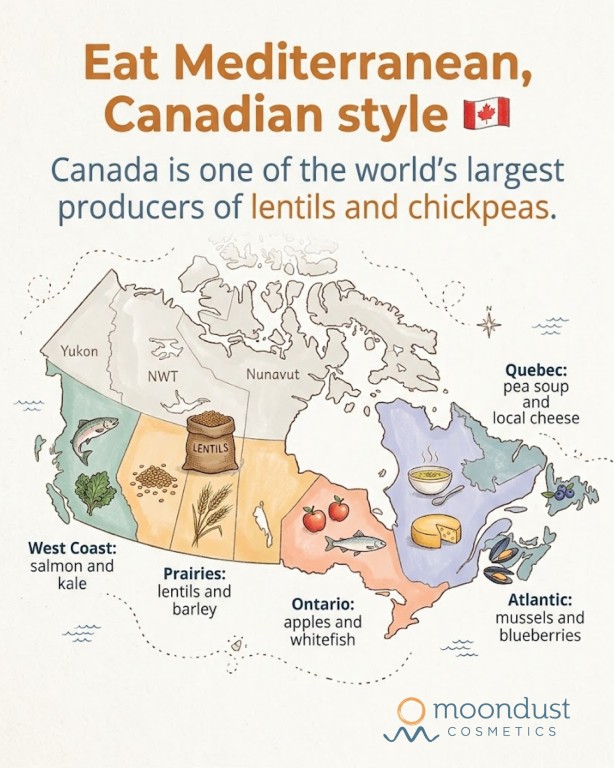
Wherever we are in the world, we can adapt to eat Mediterranean style food. Canada, for example, is one of the world’s largest producers of lentils and chickpeas, much of it grown on the Prairies, so the pantry staples of a Mediterranean winter are already in your local grocery aisle. Read on for regional produce that enriches local dietary choices.
Holiday tables can fit too: bring a maple-roasted root vegetable dish to the potluck, enjoy the butter tart or fruit cheesecake you truly love, and let the lentil soup carry you through the rest of the week. More on this will be featured in our December posts!
A closer look at Canadian regional menu samplers
Eating Mediterranean on the West Coast is made easier with the mild, wet winters. Coastal B.C. farms and winter markets keep supplying kale, chard, leeks, Brussels sprouts and hardy roots, which roast beautifully with olive oil, garlic and rosemary or simmer into a white bean and kale soup. For those who eat fish, wild salmon, mussels and oysters echo the Mediterranean love of seafood, while lentils, chickpeas, tofu and a roasted squash and barley bowl keep plant-based eating satisfying. Island and Fraser Valley hazelnuts make a sturdy snack, and frozen local blueberries brighten oatmeal.
The Prairies (Alberta, Saskatchewan, Manitoba) have long, dry and very cold winters with little fresh local produce from November to May. That makes the Prairies a natural fit for the storage-friendly side of the diet like lentil, chickpea and pea items making legumes the star. Root vegetables (carrots, beets, potatoes, onions, cabbage) store well, and the region’s wheat, oats, barley and increasingly local ancient grains cover the whole-grain side. Sunflower seeds and canola oil are local fats, with olive oil as the Mediterranean staple. Fish tends to be freshwater (pickerel/walleye, whitefish, trout) or frozen. Hearty soups like borscht (minus much of the extra cream & butter), stews and grain bowls suit the climate, and frozen vegetables and Saskatoon berries are a practical way to keep variety up. Vitamin D matters even more here, given the short, dark days.
Ontario has the widest range. Southern Ontario’s Niagara and Norfolk areas grow apples, pears, winter squash, and greenhouse vegetables supply tomatoes, cucumbers and peppers through the cold months. Local soybeans and white beans, whole grains from Ontario mills, and walnuts and sunflower seeds are available. Great Lakes, whitefish and trout are the local fish option. Winter farmers’ markets and root cellars are common, and cities have excellent access to Italian, Greek and Middle Eastern grocers, so Mediterranean ingredients like good olive oil, chickpeas, tahini and olives are easy to find.
Quebec has a famed food culture of its own. Apples, maple, root vegetables, cabbage and winter squash are staples, along with local pea and bean dishes, such as traditional pea soup. Local cheeses and the province’s artisanal producers fit the Mediterranean emphasis on moderate dairy. Maple syrup is a nice local sweetener, used sparingly. The challenge is that traditional winter fare can be heavy on pork, cream and pastry, so the Mediterranean approach is more about rebalancing: more legumes and vegetables, lighter portions of the rich dishes, and fish like Gaspé or St. Lawrence fish where you can find it.
In Atlantic Canada locals rely on the ocean’s yield of mussels, haddock, mackerel and herring that echoes the Mediterranean love of seafood and are often easier to find fresh than elsewhere in the country. Annapolis Valley apples, wild blueberries, and storage-friendly roots like carrots, beets, turnips and cabbage carry the season, while split peas, beans and oats tie the pattern to long-standing local traditions. Roast the vegetables with olive oil and herbs, keep the salt pork and gravy for the special occasions, and let a pot of pea or bean soup see you through the week. With long, dim winters, vitamin D is again something to discuss with health practitioners.
For more posts on the irreplaceable habits of healthy food, movement, sleep, or sun protection for our health, visit the Moondust Cosmetics® website.
Join us on social media
Facebook, Instagram, YouTube.
Drop a line to comment or send in a question (EMAIL) info@moondustcosmetics.com