What Your Skin Needs to Thrive in 2026

May is Skin Cancer Prevention/Melanoma Awareness Month, and so in this post Dr. Moondust, cancer biologist and founder of Moondust Cosmetics®, focuses on how we can have both beautiful and healthy skin. Read on for tips rooted in science and reminders of the everyday beauty and care routines that support sun safety, prevention, nutrition, and a peek at the powerhouses of health and longevity in each of your cells.
In our last blog on AI we learned that advances in technology can help significantly with screening and personalized treatments for many cancers, including skin cancer. While AI can scan the literature and existing data more efficiently for analysis and catch it earlier for better outcomes, our health is still very much in our very human hands.
What we know about the basics of good skin care:
Our good habits include hydration to keep skin supple, so we drink our herbal teas with special anti-inflammatory benefits & water. We eat veggies & fruit for vitamins, minerals, and antioxidants which are all key components for healthy, glowing skin and plan balanced meals for nutrition and to supply the building blocks for repair. Our sleep allows regeneration. And we use sun protection (preferably with safe mineral-based sunscreens like zinc oxide) to prevent damage before it starts and moisturize as needed in our daily beauty and care routine, right?
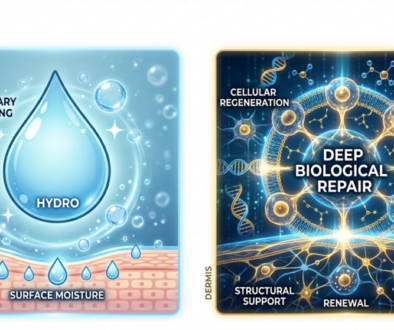
Healthy skin is not only about what you put on it, but also how well it functions from the inside out. Our skin is a living, ever renewing organ. And skin stem cells help the outer layer replace itself entirely every four weeks! Those stem cells run on energy.
Meet your mitochondria
Mitochondria are often called the “powerhouses” of our cells because they generate the energy required for cells to grow, repair, and renew.
In skin, mitochondria fuel:
· Cell turnover
· Barrier repair
· Thickness and resilience
· Calm, balanced responses to stress and inflammation
Mitochondrial efficiency declines as we age, but also when skin is under chronic stress. When energy drops, renewal slows. Skin becomes thinner, more sensitive, more reactive, and slower to recover.
Think function rather than wrinkles when you next look at your skin, and you might be kinder to the face in the mirror.
Note: There are functional consequences of thinning skin. Skin ageing can impact immune function and even brain health. Do remember that our skin is the largest organ, and caring for it is not vanity; it is overall health
What Skin Cells Actually Need (Hint: Not Sugar)
Mitochondria are a bit fussy about what fuels them best. But they do thrive on:
· Healthy lipids (fats) — essential for cell membranes and energy
· Antioxidants — to neutralize oxidative stress
· Cofactors (like NAD) — which help convert nutrients into usable energy
It brings us back to lifestyle with diets rich in healthy fats, consistent sleep, stress regulation and protection from the biggest stressor of all, which is environmental damage.
Sunlight plays a role in mood, circadian rhythm, and vitamin D production. But when it comes to skin, unprotected sun exposure is one of the greatest sources of mitochondrial damage.
UV radiation damages cellular DNA and increases oxidative stress. It accelerates mitochondrial decline and breaks down the skin’s protective barrier. Over time, this doesn’t just age skin — it increases the risk of skin cancer, the most common cancer worldwide. This is where your skincare becomes healthcare.
Daily sun protection helps preserve skin’s immune defenses as well as our total cellular energy systems.

How daily lifestyle choices add to long-term resilience
Nutritional elements that support skin health and its living surface microbiome work amazingly through digestion or what is known as the gut-skin axis, to maintain skin integrity and a balanced microbiome.
Key Nutritional Elements for Skin Health
- Omega-3 Fatty Acids (EPA & DHA): Reduce inflammation, maintain the skin barrier, and treat conditions like acne, psoriasis, and eczema.
- Omega-6 Fatty Acids (LA & GLA): Linoleic acid (LA) is crucial for skin barrier integrity, while gamma-linolenic acid (GLA), helps reduce skin dryness and inflammation.
- Vitamin A & Carotenoids: Provide photoprotection against UV damage.
- Vitamin C: Is essential for collagen synthesis, improves skin hydration, and protects against UV damage.
- Vitamin E: Works synergistically with Vitamin C to protect against UV-induced damage and reduce oxidative stress in skin lipids.
- Zinc: Crucial for wound healing, reducing inflammation, regulating sebum (making it effective for treating acne), and powering antioxidant machinery in the body like copper, zinc superoxide dismutase and metallothioneins that reduce oxidative damage to cells that can result in scientific sunburn and/or contribute to lines on the face.
- Copper & Selenium: Copper helps with collagen maturation and antimicrobial defense. Selenium is essential for antioxidant enzymes that protect the skin from UV-induced damage.
- Silicon: Induces collagen secretion and improves skin elasticity.
- Polyphenols: Prevent collagen degradation, reduce UV damage, and modulate the gut microbiome.
These nutrients and a diverse diet can directly support your skin’s health, structural integrity, and the delicate balance of its microbiome.
See Suncare for your skin type.
Why Skin Cancer Deserves Special Attention
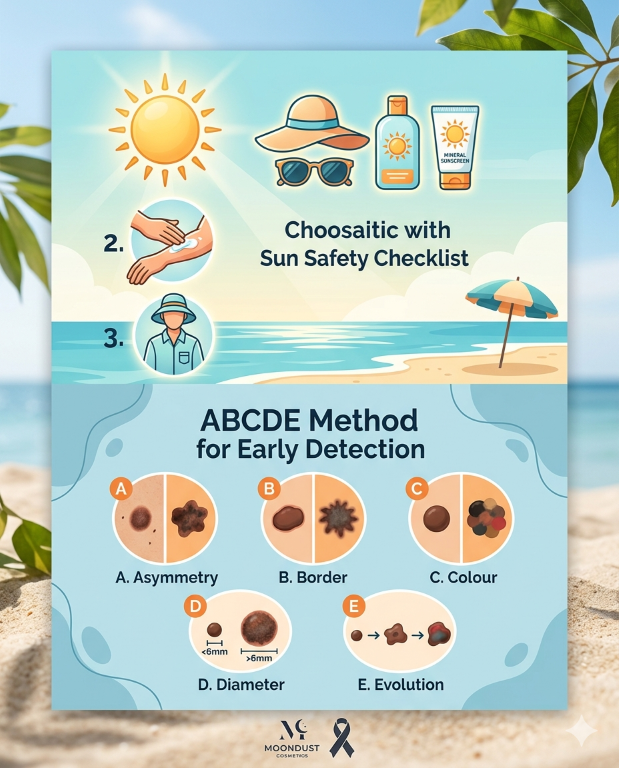
Skin cancer is among the most common and preventable cancers on earth. Melanoma alone kills over 57,000 people in the United States annually, yet when caught early, survival rates exceed 98%. Learning to spot skin cancer using the ABCDE method that dermatologists use can be the difference between a minor procedure and a life lost.
The Three Skin Cancers You Need to Know
Melanoma is the most dangerous, arising from pigment-producing cells. It spreads rapidly if undetected, making early AI-assisted screening critically important. Basal Cell Carcinoma (BCC) is the most common form, rarely fatal, but can cause significant tissue damage if ignored. Squamous Cell Carcinoma (SCC) sits between the two in severity, with a meaningful risk of spreading if left untreated.
While Yoshua Bengio’s AI tools can detect a malignant lesion from a photograph with dermatologist-level accuracy, we can rely on this guide to help us detect potential skin cancer in the skin we live in, early.
The ABCDE Method to Spot Melanoma
A guide to spotting signs: Asymmetry, Border irregularity, Colour changes, Diameter (larger than a pencil eraser), and Evolving (changing).
Asymmetry - One half doesn’t match the other half in shape
Border - Edges are ragged, notched, or blurred
Colour -Multiple shades of brown, black, red, or white
Diameter – Larger than 6mm (the size of a pencil eraser)
Evolution -Any change in size, shape, colour, or new symptom
To not: Excerpts of a contribution to a cancer text by Dr. Moondust on skin cancers in general:
In contrast, non-melanoma Cancer may adhere to the five signs of Celsus & Galen which include pain & irritation, excessive redness in the earlier stage, a tumour or swelling, and a loss of function in the affected area.
Finally, skin cancers (melanoma and non-melanoma) are the most common cancers in humans with a light skin tone or in those with little melanin and they are on the rise, particularly in ageing populations (46). Melanoma occurs mainly on the back and legs, often in areas that are not exposed to sunlight, and involves moles or pigment-producing cells (melanocytes), while non-melanoma skin cancer occurs predominantly in areas of the body that are regularly exposed to sunlight in cells of the epidermis (keratinocytes) in people who are susceptible to sunburn. Melanoma presents as a darkish patch of colour, whereas non-melanomas (basal cell carcinoma and squamous cell carcinoma) can present as a reddish/pinkish growth, a red sore, or a wart-like growth. New research suggests that ageing may also have an effect on rate of apoptosis in various tissues since senescence appears to be associated with the deregulation of programmed cell death such that there is an increase of apoptotic activity in certain cell types while there is a decline in others (13). Thus, preventing the negative effects of UV-radiation is important in the elderly as this dysregulation of apoptosis is likely to play a role in their high skin cancer incidence.
Prevention is still our best plan.
Use the ABCDE framework above and conduct monthly examinations. Use a full-length mirror and a hand mirror for hard-to-see areas. Schedule an annual checkup with a dermatologist.
Never use tanning beds as they increase melanoma risk by 75% when used before age 35. There is no such thing as a “safe tan” from this type of UV exposure.
Take heart in your habits and refresh your best practice tips here (previous complete post)
See more posts on the foods, habits and lifestyle choices for glowing health Moondust Cosmetics® website.
Join us on social media
Facebook, Instagram, YouTube.
Drop a line to comment or send in a question (EMAIL) info@moondustcosmetics.com