What’s Actually in Your Hair Extensions? A New Study Has Answers
It’s time for that summer ritual for most women. It is assessing the effect of the sun, not only on our skin, but on our hair. We cover up We moisturize. We seek salon-level help and think ahead to September when a return to routine and new events will require showing up with hair with some style and healthy tending. Moondust has some tips and cautions if hair extensions are part of your solution to looking well-kept with confidence and less effort.
A new peer-reviewed study tested the actual chemical makeup of hair extensions. Read on to learn what the research shows.
The Ingredient List with Cause for Concern
Unlike the food labels we now scour for ingredients, hair extension packages tell you almost nothing. Promises like: “Flame resistant.” “Water repellent.” “Toxic-free!” don’t reveal what’s actually in the fibre, because in the U.S., there’s essentially no requirement that it does.
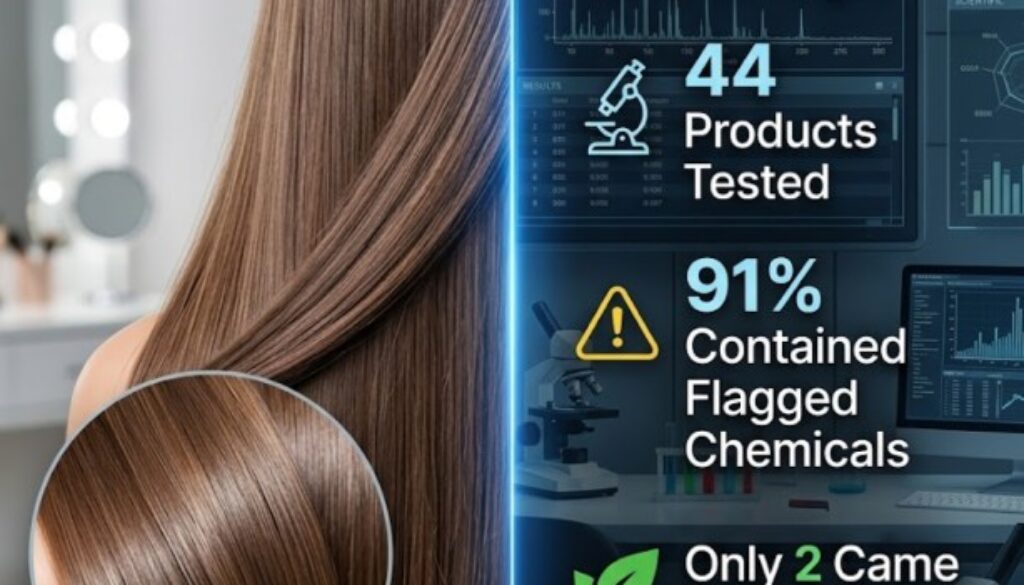
A team of researchers, led by Elissia T. Franklin at the Silent Spring Institute, bought 44 hair extension products to see for themselves. They were synthetic ones like Kanekalon and Mastermix, plus human hair, banana fibre, and silk. Each was run through a lab technique that’s basically a forensic chemical audit. Instead of testing for one or two suspected ingredients, they looked for everything.
They found 933 distinct chemical signatures. Of the 169 they could confidently identify, at least 12 have been associated with cancer, birth defects, or reproductive issues seriously enough to land on California’s Proposition 65 hazardous chemicals list.
91% of the products tested contained at least one flagged chemical. Only two, out of 44, came back clean. Astounding and worrisome.
This post draws on the work of Elissia T. Franklin and colleagues at the Silent Spring Institute, published in Environment & Health (2026), analyzing the chemical composition of commercially available hair extensions.
The Story Is About Who Wears Extensions, Why and How Often
Aside from the specific chemicals the team looked at or brands, their foremost concern was for who actually wears extensions, and how often. Our examples, like the study, are based on USA data.
More than 70% of Black women in the U.S. use hair extensions at least once a year — including protective braiding styles that are a genuine cultural staple. The practice was shaped over generations by forces well beyond fashion: the slave trade, colonialism, and Western beauty standards that have long treated natural Black hair as something to manage, hide, or apologize for. That history is part of why extensions and braiding aren’t just a beauty choice for a lot of women — they’re closer to a tradition, a form of protection, and a rite of passage rolled into one.
It lands differently when the products at the centre of that tradition turn out to be so under-tested! As Franklin, the study’s lead author, put it, these products don’t just carry a single risk in isolation — worn repeatedly over time, the exposures to multiple chemicals add up.
A high-risk pattern for black hair care products
This isn’t the first incident of concern. Chemical hair relaxers, another product long associated with styling Black hair, have already been linked in prior research to a higher risk of uterine cancer. This new study on extensions fits into that same, uncomfortable pattern: haircare products used disproportionately by Black women, with disproportionately little safety scrutiny behind them.
To note: occasional hair extension users are not exempt from risk to their safety.
More about the chemicals
One finding alone was about a class of chemicals called organotins. These compounds are normally used to stabilize PVC plastic. Nearly 10% of the tested products contained them, all from unlabeled synthetic fibres where the brand didn’t disclose what the fibre was actually made of.
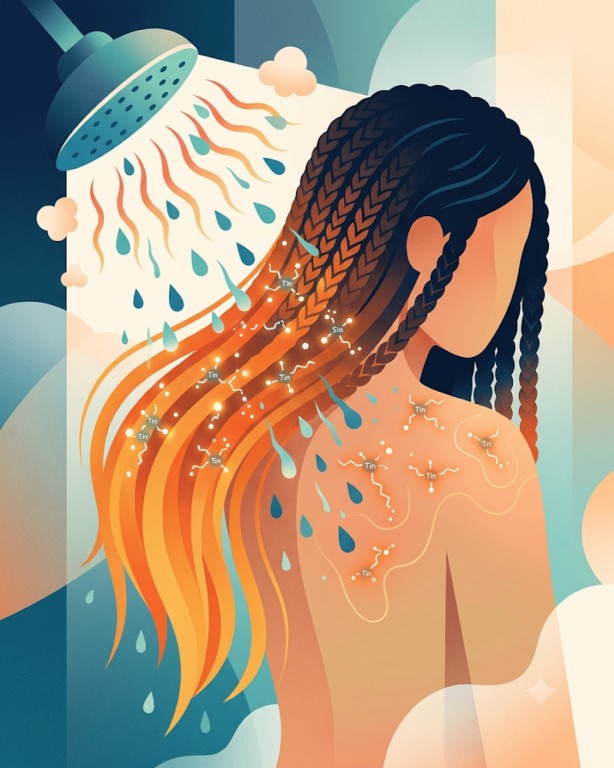
These are linked to endocrine-disrupting effects, and in some samples, concentrations exceeded the European Union’s legal safety limit for consumer products. When researchers simulated a hot shower, the compounds leached out, which means they can transfer to skin during totally normal, ordinary use. You could be washing your hair, standing in a steamy bathroom, doing absolutely nothing wrong and suffering toxic effects.
What Marketing Hid
As for most consumer products, a well-worded label can hide a great deal. Researchers found that products marketed as “toxic-free” or “phthalate-free” didn’t uniformly test clean. In fact, some of the banana fibre extensions marketed as containing no phthalates did contain phthalates. Again, the same hormone-disrupting chemicals used to soften plastics.
Meanwhile, the products with the fewest hazardous chemicals detected weren’t necessarily the ones with the loudest green marketing. They were, more consistently, the ones that actually disclosed what the fibre was made of in the first place. Transparency, it turns out, was a better predictor of safety than a good tagline.
Tips for Users of Hair Extensions
It is worthy to note that the researchers identified what’s present in these products used by so many women. They have not yet measured the exact level of risk that translates to the alert level for someone wearing extensions three times a year for a special event or for someone wearing them as a regular, recurring part of how they care for and protect their hair. More time and funding must go into pinpointing answers to those questions.
In fact, as mentioned, this kind of testing is new. The researchers themselves are careful to say that more research is needed before regulators can determine what level of oversight these findings actually justify.
Still, not knowing ‘fully’ does not let the industry or the users off the hook from thinking about it. Seriously. These tips may add to peace of mind and valuable care for any level of use:
Favour products that actually disclose their fibre composition. If the packaging or the brand’s website can’t tell you what the hair is made of, that itself points to worse findings in this study.
Treat “nontoxic” and “toxic-free” as marketing, not verification. Until labelling laws catch up. It’s not that brands are necessarily lying — it’s that nobody’s checking!
If you’re heat-styling or sealing braids with a flame, know that “flame resistant” claims are often tied to *chlorine-based flame retardants, not just a convenience feature. *This is its own category worth knowing about.
A pre-wash with diluted vinegar is a home remedy some people use before wearing synthetic extensions. It showed limited effect at removing some of these compounds in the study, so it’s not a fix, more of a nice-to-have.
What’s truly at stake?
Scrutinizing every strand of a product meant to simplify your routine — to add ease, confidence, and a little style to facing the world, isn’t how anyone wants to spend their time. But like it or not, that’s where we are: reading labels has become part of the self-care routine itself, not just an act of vanity or convenience. In these times of mass production and marketing, that may mean reading labels closely, whether it’s for food, fashion, or any health or convenience product.”
Ask questions. Read the fine print, if there is any. And if there isn’t any, let that be information in itself.
Find more supporting information on the deep dive list of ingredients free of charge at https://pubs.acs.org/doi/10.1021/envhealth.5c00549
Discover videos and posts on staying safe in the summer sun and enjoying every step of life with vigour on our Moondust Cosmetics® website.
Join us on social media
Facebook, Instagram, YouTube.
Drop a line to comment or send in a question (EMAIL) info@moondustcosmetics.com